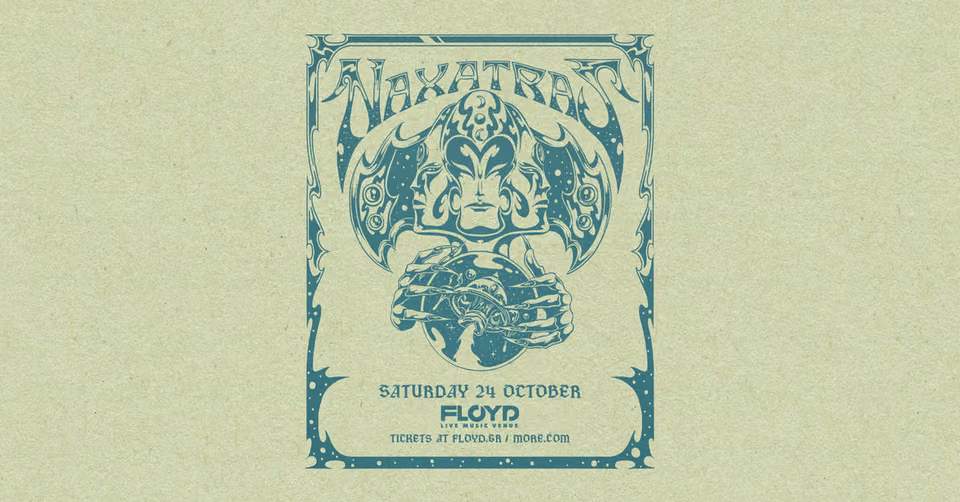
Naxatras are a Greek psychedelic and progressive rock band formed in Thessaloniki in 2012 by guitarist and vocalist John Delias, bassist and vocalist John Vagenas and drummer Kostas Charizanis. Originally established as a power trio, the band developed through extended rehearsals, improvisation and a shared interest in 1970s psychedelic rock, space rock, progressive music, funk and heavy guitar-driven grooves.
Their sound is built around the interaction between the musicians rather than conventional lead and backing roles. Delias’s effects-heavy guitar moves between blues, acid rock, progressive melodies and heavier riffs, while Vagenas and Charizanis create a flexible rhythm section capable of shifting from hypnotic grooves into more structured and rhythmically complex passages. Vocals are used selectively, leaving space for long instrumental sections to develop through repetition, dynamics and gradual changes in atmosphere.
Naxatras recorded their self-titled debut album at Magnetic Fidelity with engineer Jesus I. Agnew. The band performed the material live during a single day, using entirely analogue equipment and recording directly onto cassette tape. Released independently in 2015, the album introduced their warm, unpolished sound through tracks such as “I Am the Beyonder,” “Shiva’s Dance,” “Waves” and “Ent.”
The album spread internationally through Bandcamp, YouTube and independent psychedelic music communities, becoming an underground success without the support of a conventional label. Its combination of analogue production, relaxed improvisation, heavy riffs and cosmic atmosphere established Naxatras as one of the most visible bands emerging from Greece’s psychedelic and stoner rock scene.
Their second album, II, followed in 2016. Recorded live onto reel-to-reel tape and transferred directly to the final master, it developed a more spacious and immersive form of the band’s early sound. Songs including “Proxima Centauri,” “Sisters of the Sun” and “The Great Attractor” moved between astronomical imagery, spiritual themes and patient instrumental exploration.
The third album, III, was released in 2018 and expanded the band’s music through progressive rock, jazz, funk and more elaborate arrangements. Tracks such as “You Won’t Be Left Alone,” “Prophet” and “White Morning” demonstrated a stronger compositional direction while preserving the fluid interplay of their earlier recordings.
During this period, Naxatras also released Live Rituals at Gagarin 205, recorded during a sold-out performance in Athens. The album captured an essential part of their identity, with familiar songs becoming heavier, more elastic and more immersive in a live setting.
For their fourth studio album, the band added keyboardist and synthesizer player Pantelis Kargas, transforming the original trio into a quartet. Released in 2022, IV marked a major change in both production and composition. The band moved beyond the strict live-to-tape approach of its first three albums, using multitrack recording to accommodate keyboards, electronic textures, percussion and more detailed arrangements.
IV introduced the fictional world of Narahmon, combining science fiction, mythology and cosmic fantasy. Its music drew more openly from progressive rock, electronic music and Eastern scales while retaining the grooves and psychedelic atmosphere associated with the band’s earlier work.
Their fifth studio album, V, arrived in 2025 and expanded the mythology introduced on IV. Functioning as a narrative prequel, it follows the Spacekeeper, a traveller sent to protect Narahmon from an approaching force known as the Void. The album combined progressive and psychedelic rock with synthesizers, strings, flutes, hand percussion and influences drawn from Greek, Turkish and broader Eastern musical traditions.
Although Naxatras began as an improvisational trio, their later work has become increasingly structured and conceptual. Jamming remains central to their creative process, but their finished recordings are shaped around atmosphere, narrative and carefully developed musical movement.
The band have also maintained a strongly independent working model, managing much of their own activity, producing physical releases and collaborating with a close circle of engineers, designers and filmmakers. Visual artist Christopher Toumazatos has played an important role in developing their imagery, giving form to the cosmic travellers, lost civilisations and mythological landscapes that accompany their music.
Across their catalogue, Naxatras have evolved from raw analogue psychedelic rock into a broader form of progressive and cinematic music. Their work remains grounded in groove, warmth and collective performance while incorporating increasingly detailed arrangements, electronic textures and conceptual storytelling.